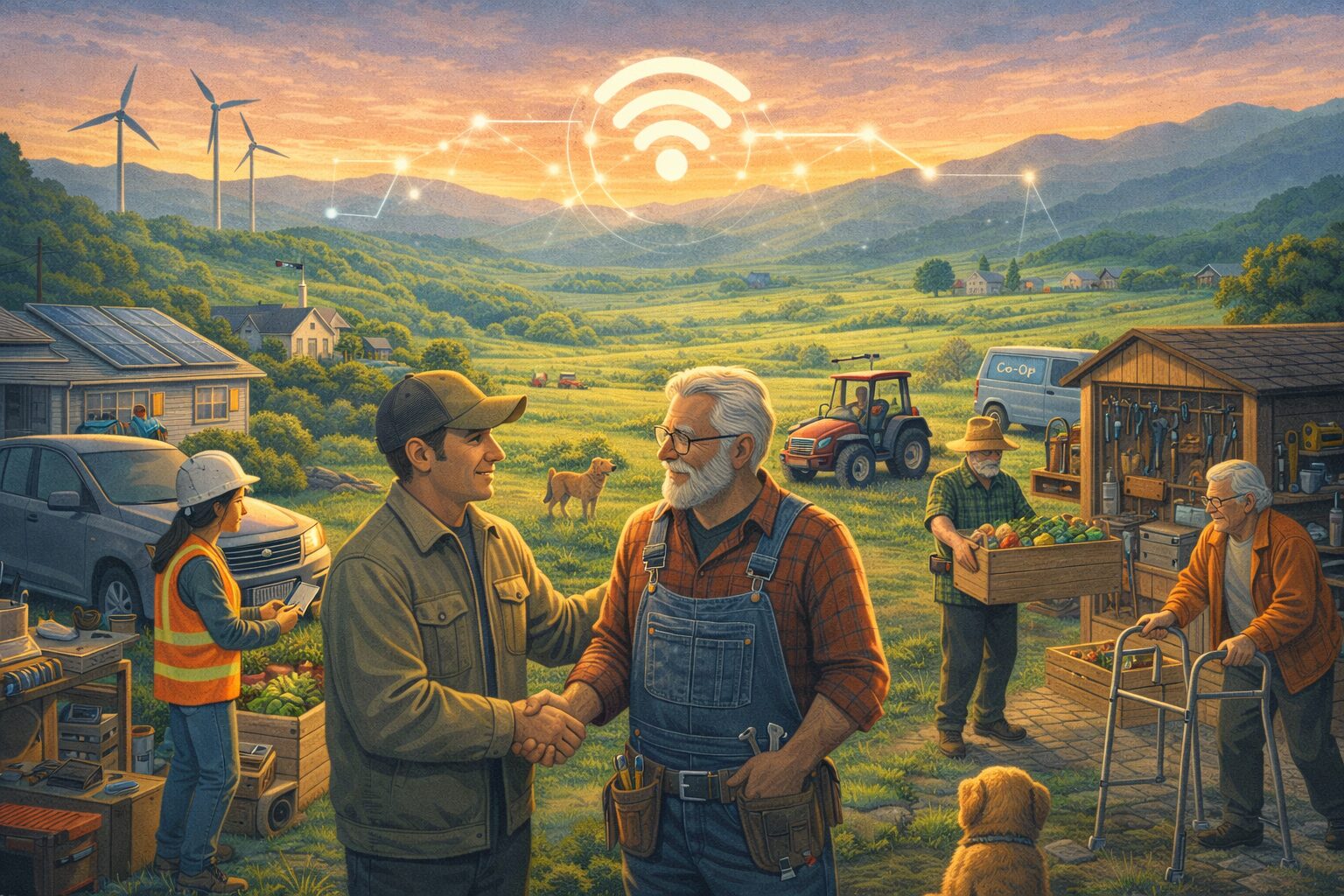
By: Sam & Lyra
Opportunities, constraints, and why rural isn’t “hard mode”—it’s different mode
Most people design community systems as if the default world is a city: dense neighborhoods, short travel times, lots of institutions, and a constant churn of people and services. Then they try to “scale it down” to rural places.
That’s backwards.
A holon where the overwhelming majority of people are rural—like Russell County’s ~80% rural split—doesn’t need a smaller version of a metro strategy. It needs a different strategy with different assumptions about distance, trust, infrastructure, labor, and what “capacity” even means.
If we want Play the Planet to work anywhere, we have to treat urban/rural composition as a core gameplay variable—like climate, biome, or difficulty modifiers in a game. Same core rules. Different meta.
The rural reality: distance is the final boss
Rural life has a built-in tax that cities barely feel:
- Travel time isn’t “overhead.” It’s a structural constraint.
- Fuel costs aren’t an annoyance. They’re a gate.
- “I’ll swing by after work” becomes a 45-minute one-way trip.
- A single broken truck, icy road, or dead battery can knock someone out of participation for weeks.
This means rural holons must optimize for trip consolidation and distributed nodes, not centralized hubs.
If an urban holon is a beehive, a rural holon is a mycelium network. The goal isn’t “bring people to the center.” The goal is “make the center portable.”
Opportunity #1: Trust is stronger and reputation actually matters
Rural communities are often high-trust environments with long memory. That has downsides (gatekeeping, grudges), but for PtP it’s a cheat code if we design for it.
In a metro, reputation systems struggle because people churn and anonymity is easy. In rural spaces:
- “Social rating” means something because people can verify the work.
- Bad actors burn out faster because word travels.
- Guilds and teams can persist for years, not months.
This suggests rural holons should lean hard into:
- local verification (neighbors validating neighbors)
- repeat collaboration (teams that do quests together)
- higher weight on long-term track record than on “viral” participation
In game terms: rural zones are where “faction reputation” mechanics shine.
Opportunity #2: Land access changes the entire food game
Rural holons have something cities don’t: space.
Not everyone has acreage, but there’s more potential for:
- gardens with real yield
- shared greenhouses
- small livestock where permitted
- community orchards
- partnerships with farms that have surplus/seconds
- storage infrastructure (freezers, pantries, root cellars)
Urban food strategy tends to be: distribution, purchasing power, efficient delivery.
Rural food strategy can be: production + storage + distribution.
That’s a massive advantage—if we build the right quests:
- “Plant X square feet of staple crops”
- “Build a winterizing kit for 10 households”
- “Co-op freezer node installation”
- “Volunteer driver routes for pantry deliveries”
The gameplay loop can shift from “find resources” to “increase local capacity.”
Opportunity #3: Energy strategies are more flexible
Urban energy is infrastructure-bound. You can do rooftop solar and efficiency, but you’re constrained by renters, building codes, shared structures, and grid complexity.
Rural holons can pursue a wider range:
- rooftop solar on single-family homes
- ground mounts
- small wind where viable
- shared solar projects
- battery backups for vulnerable households
- microgrid experiments on campuses, churches, co-ops, or farms
The win condition isn’t “everyone buys panels.” It’s “we reduce fragility and increase local resilience.”
Rural holons should treat backup power capacity as a civic resource—because storms and outages hit harder when you’re far from services.
Opportunity #4: The “acts of service” quest economy maps cleanly to rural needs
Rural communities have endless real needs that are visible and measurable:
- weatherization
- minor repairs
- transport for medical/food access
- elder support
- yard work for disability households
- small-scale home maintenance
- emergency response help
These are perfect “proof of work” quests because outcomes are tangible and verifiable.
A rural holon can mint Gc in ways that are hard to replicate in cities without running into bureaucracy. Rural is where PtP can feel immediately useful, fast.
Challenge #1: Participation will be lumpy, not smooth
In cities, you can get steady engagement because there are more people within a small radius.
In rural holons, engagement will cluster:
- certain communities are active
- others are quiet
- a single organizer can change everything
- a single burnout can collapse a node
So rural holons need explicit mechanics for redundancy:
- “backup steward” roles
- substitute caregiver networks
- route coverage and “on-call” quest rotations
- guild-based teams that can absorb absence
Design principle: Never allow a critical function to be held by one person without a successor.
Challenge #2: Transportation is both a limiter and a quest category
A rural holon that ignores transportation will fail.
Transportation isn’t a side feature. It’s a primary layer:
- volunteer driver networks
- route planning
- ride-sharing with trust gates
- deliveries as compensated quests
- “trip bundling” systems (one run handles three households)
This is where PtP should be honest: rural capacity increases when you reduce unnecessary miles. Your best “efficiency tech” might be a schedule and a shared Google calendar.
In game design terms: movement costs are high. So you reward quests that reduce movement costs for everyone else.
Challenge #3: Digital infrastructure is uneven
Rural broadband gaps are real. Some households rely on spotty cell connections. That matters because PtP is software-driven.
So the rural-first version of PtP must support:
- low-bandwidth interactions
- asynchronous workflows
- mobile-friendly proof submission
- offline capture with later upload
- “phone-in” verification options via trusted stewards
If a system requires constant connectivity, it’s an urban bias baked into the mechanics.
Challenge #4: Institutions are fewer, but influence is concentrated
Rural holons often have a handful of institutions that matter:
- one hospital system
- one or two utilities
- a couple major employers
- a small set of churches
- a co-op or extension office
- a school district
That’s an opportunity and a risk.
A rural holon can move fast by partnering with just a few anchors—but it can also be kneecapped if those anchors oppose it. The right approach is:
- show value quickly through visible wins
- keep politics out of the core experience
- offer institutions “opt-in” participation, not control
Strategy: Rural holons should be node-based, not hub-based
Here’s the simplest “rural holon strategy stack”:
1) Build local nodes
Instead of one central hub, create multiple nodes:
- pantry node
- tool library node
- freezer node
- weatherization node
- energy resilience node
Each node has:
- a steward
- a backup steward
- a clear quest menu
- a local “radius of service”
2) Optimize for route economics
Every quest system should ask:
- Can this be bundled with other tasks?
- Can it be done at a node closer to the recipient?
- Does it reduce future travel?
3) Treat emergency restoration as premium work
Rural failures compound: a broken water line, dead furnace, or car trouble can remove someone from participation entirely. Emergency restoration quests should pay more because they preserve the holon’s capacity.
4) Make reputation the foundation
In rural holons, reputation is currency before currency. Gate higher-trust actions (like emergency quest posting, transport gigs, or guild tax privileges) behind demonstrated rating + sample size.
The takeaway: rural isn’t “less capable”—it’s differently capable
Rural holons have more land, more practical work, and often stronger community memory. They also carry heavier costs of distance, fewer services, and more fragile redundancy.
If PtP treats rural like a watered-down city, it will fail.
If PtP treats rural as its own game mode—with mechanics tuned for nodes, routes, redundancy, and resilience—it can become the most impactful version of PtP, because the needs are real and the wins are visible.
Leave a Reply